How to Upload an Audiobook in Youtube
It happened in a moment of weakness—even though I knew better—just late one nighttime earlier this month, I read the Amazon reviews for my book . Alternatively inflating and torturing my ego, I went through negative and the positive reviews. Amidst the praise (and intense dislike), I defenseless a strange comment : Someone mentioned that they liked the book but wanted to alert readers to the fact that they could detect the audiobook for free on YouTube.
What? Bold information technology was a mistake, I moved on. And so another person mentioned information technology. Then I looked. They were correct. A quick search on YouTube uncovered the audiobooks of my last two books, streamable in their entirety on YouTube, uploaded past a random user. One video for The Obstruction is the Way , a book I released in 2014, had more than than 16,000 listens. Information technology might not seem like a ton only the volume had sold about 50,000 copies in audio—an boosted 30% of that effigy pirated information technology through a unmarried video?
Brand no mistake, this is directly piracy. The video was zip less than the raw half dozen hour audio file I recorded in The Block Business firm studios in Austin for publication past Tim Ferriss Audio , accompanied by a thumbnail of the book'south cover. There weren't any pre-roll ads in front of the video but in that location were certainly regular YouTube banners and sponsored videos displayed against the book. Thousands of people had watched (or as I imagine, listened with the tab open on their browser while they worked) my volume instead of buying it.
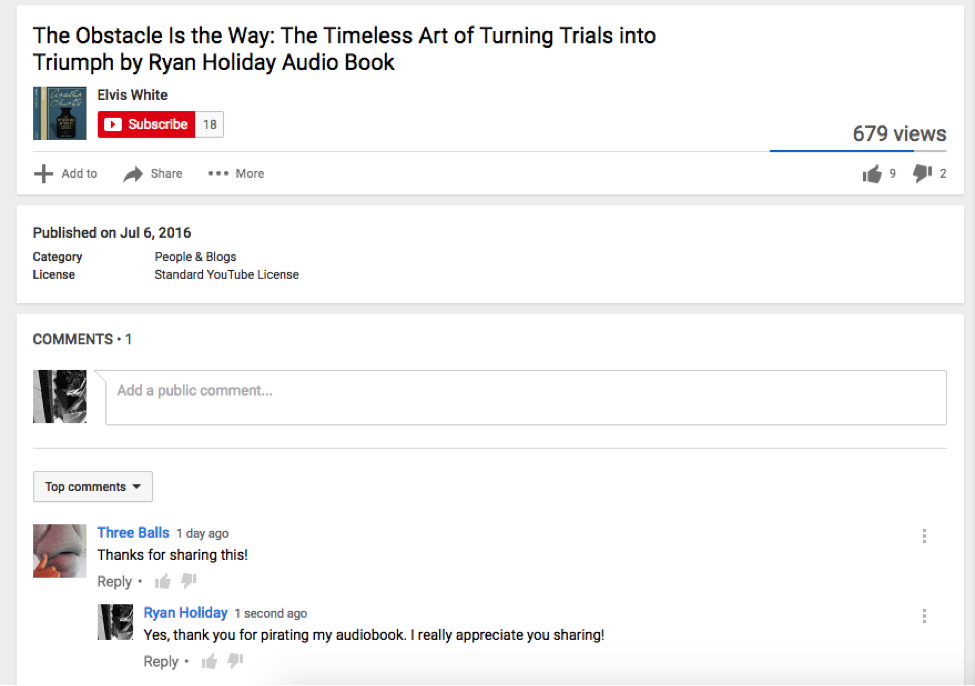
YouTube's proposition algorithm made information technology clear that I wasn't the merely author affected. In fact, a cursory look found audiobooks from authors Tim Ferriss , Robert Greene , Richard Branson , James Patterson and Stephen Male monarch —some with as many as 162,000+ views and 120+ comments. (But look at this YouTube search for the phrase "full audiobook" ). On forums, I found comments from authors like Diana Gabaldon, best known for her Outlander series, who complained almost seeing her books popular upwardly in pirated class on YouTube. I even saw an instance on reddit of a user reporting to see pirated audiobooks where instead of the author narrating, the fan (or whomever) had simply recorded a computer plan reading the entire book and uploaded that.
There'southward too clearly a rampant amount of podcast piracy going on. Fifty-fifty though many podcasts are given away for costless on iTunes or on the podcaster's website, users are non entitled to re-mail them on YouTube and capture advertising revenue from them. You can detect an episode from Dan Carlin's popular Hardcore History that has nearly x,000 views. One user remarked in the comments that y'all actually have to pay for it on Dan's website. A quick await on reddit shows that Dan has dealt with similar situations in the past with channels and videos beingness taken down for copyright infringements. In that location are episodes from Joe Rogan, another podcast heavyweight, with several videos hitting 600,000+ views . But at to the lowest degree for many of these shows, the podcaster is able to embed ads inside the audiofile and thus partially profit from this course of consumption.
Audiobooks accept no such advantage. Given that audiobooks typically retail for between $15 and $30, this amounts to millions of dollars of lost revenue for authors and publishers. In an industry that has been repeatedly disrupted in the final decade—with bookstore closings, the rise of self-publishing, ebooks and a vast explosion of alternative forms of entertainment—this is revenue that few authors (and traditional publishers) can afford to lose.
So what's going on? It'south clear to me that the recent rapid ascent of audiobooks has dramatically outpaced the power of publishers big and small to stay alee of the piracy. I hateful, who would have thought that anyone would want to pirate 8 hours of someone reading something out loud? Having signed several rights deals for audiobooks with multiple companies, I can tell you that none of the contracts fifty-fifty mentions streaming rights or advertizing acquirement. They mention the sales of physical CDs and audiocassettes yet, just not a hint about potentially being included on Spotify anytime.
What that ways is that YouTube'south current piracy protections are woefully inadequate for authors and book publishers. In 2007, YouTube brought out something called ContentID which scrapes all uploaded videos to YouTube confronting massive copyright libraries which rights holders have created. It was a bright innovation. If I upload a video featuring a Taylor Swift vocal, YouTube recognizes it and gives rights holders the option to either block me from doing so or receive their portion of revenue from any advertising. The same goes for pirated tv and movie clips. It's non so elementary with audiobooks—and even if it was, most contracts brand no stipulations for streaming rights. Nor, by the way, would many publishers quality for YouTube's standards to use ContentID which land that "to be approved, [you] must ain sectional rights to a substantial body of original fabric that is ofttimes uploaded by the YouTube user community." YouTube says it volition decline you if information technology thinks its manual tools are more appropriate.
In my experience, book publishing is a business concern that is slow to adapt to modify. Many in the industry still call back their concern model includes charging for excerpts on media outlets (these are chosen "serial rights"), the fashion they used to get paid when F. Scott Fitzgerald would run a couple chapters from The Great Gatsby in The Sat Evening Mail or some other newspaper. (In fact, Observer but had an author who asked about running a brusque article adapted from their book…only to have their publisher butt in and enquire for money. Thankfully cooler heads prevailed). Worse, audiobook rights are not ever handled by the big houses whose names you might exist familiar with—Penguin, Simon & Schuster, HarperCollins, etc—instead, the rights are sold off to smaller audiobook publishers nigh exactly the style that Bulgarian translation rights would be. Many large name authors—and this is truthful for many pirated books I institute on YouTube—are represented by a much smaller visitor in sound than they are in print and ebook.
I imagine that's why when I emailed several agents and volume publishers for responses for this story, about all of them refused to reply. A number of them seemed to have no idea what I was talking about. The Authors Society? They didn't respond either—they're probably too decorated waging pointless battles confronting Amazon and Google Books (which past the way, actually make lots of money for authors and assist make their lives easier).
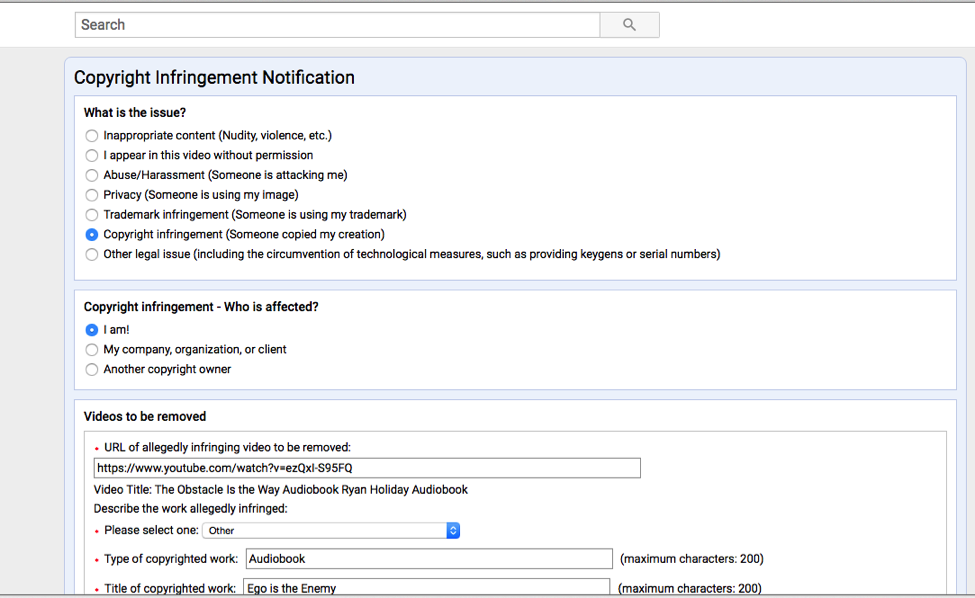
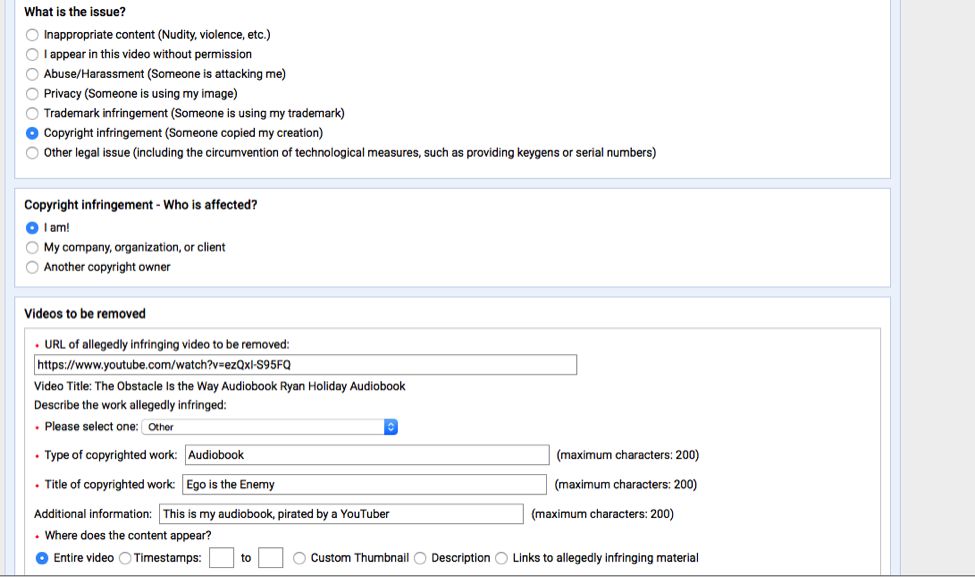
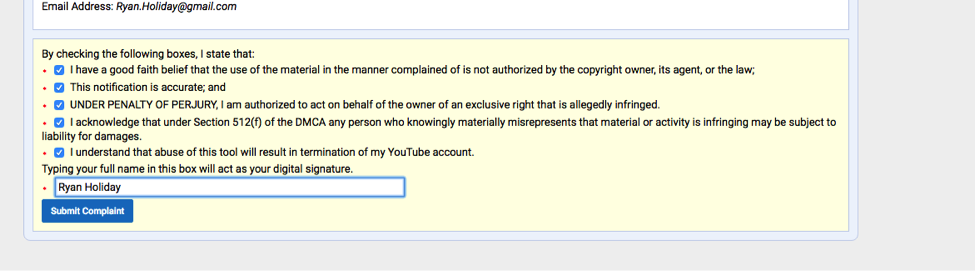
I agent I emailed did reply—mine (he was, direct affected past this piracy, later on all). I asked him what we should do. At the very least, he suggested, we could file a copyright claim with YouTube directly. So manually, using YouTube'south form ( seen here ), I filed claims confronting all of the videos infringing on my books. Within a few days, I got a response: They were coming downwardly. But having read about the travails of other authors, I know that they volition shortly be back up. I will need to file these claims over and over again. I tin can go along to file these claims as the writer but since I'm not a major publisher with a "substantial body of original cloth," I can't participate in YouTube's ContentID personally.
Which ways that the people being pirated are the ones who accept to do all the work—while the platforms and the users benefit. James Tonn, one of the smartest minds in audio publishing whose audiobook publishing business firm Podium, (which published books like The Martian , Fear The Heaven , The Terminal Tribe and Invasion ), describes the situation thusly:
"In short: nosotros play whack-a-mole. It's like NYC's graffiti policy: quick removal decreases interest. Nosotros monitor YouTube weekly and report the users who are then banned and the content removed quickly."
Information technology'due south a sad state of affairs for this industry in 2016. In the middle of writing this article, where I originally planned to commend YouTube for its hasty removal of my book afterward my claim, I plant another re-create of The Obstacle Is The Way , uploaded by a different user and had to accept a break from writing to file another claim. As for the lost sales? There's nowhere on the form to reclaim that revenue. And if at that place was, who would it get to? The publisher? Me?
I grew upwardly with net piracy. I remember the solar day in vii thursday grade when a friend chosen united states of america over to the computer in science class and showed united states this absurd new thing called "Napster." A good portion of the music on my iPhone was pirated over the years from the ever evolving parade of services which arose post-Napster: Audiogalaxy, Morpheus, Kazaa,, DC++, eMule, BitTorrent. There was even 1 in college chosen ourTunes which let you download the iTunes library of everyone in your dorm. Every bit I got older, I realized this was stupid and incorrect (and a poor use of fourth dimension) and I began to buy all the music and movies I consumed. I sympathize that piracy serves a function of discovery, especially for immature people. Half the bands I've seen in concert or bought t-shirts from, I discovered this manner .
That's not my point. I am not making some self-indulgent complaint most piracy now that information technology of a sudden impacts my wallet. From a marketing perspective, I've e'er held that word of mouth is a powerful commuter—so powerful that it won't always stick to legal means. Hell, that's precisely why I partnered with BitTorrent to promote Tim Ferriss's volume The four Hr Chef when it was banned by Barnes & Noble. I've even given away chunks of my own stuff in that location.
I also respect the fact that forrad thinking authors like Paulo Coehlo have actually pirated their own books and seen massive sales spikes because of it. Coehlo non only uploaded his own books to torrent sites in Russia—a move that drove significant foreign sales—but he'south even run ads that incorporate the entire text of his novels (piracy requiring a magnifying drinking glass I gauge). But, there is a deviation betwixt free exposure on the underbelly of the internet and i of the biggest sites in the world giving your piece of work away without your permission. Piracy isn't the biggest threat facing authors, but it is good to make certain it'due south not rampant and that bootleg copies aren't easier to access than forms of paid consumption.
The publishing industry has to adjust and deal with this. Nosotros are entering a streaming world—and contracts are going to need to be updated. They're going to need to conform for advert-revenue models and if they don't, then people volition pirate. Legal departments are likewise going to have to piece of work harder and a lot faster. For its part, YouTube needs to go its act together and offering tools straight to publishers and authors. Audiobook piracy is real and clearly growing. The idea that songs and boob tube and films all deserve protections from ContentID simply authors don't is absurd.
ContentID is nearly 10 years former. YouTube is a multi-billion dollar company owned past an even bigger multi-billion dollar company. Audiobooks are non only hither to stay, they volition become an increasingly big percent of income for authors. The Authors Social club, agents, authors and publishers besides as platforms are going to demand to get information technology together. Or they're going to find another green sprout for the industry trampled out by poor strategy and slow uptake.
Ryan Holiday is the acknowledged author ofEgo is the Enemy and The Obstacle is the Way. Ryan is an editor-at-large for the Observer, and he lives in Austin, Texas.
He's also put together thislist of 15 booksthat you've probably never heard of that will alter your worldview, assist yous excel at your career and teach you how to live a better life.

williamsdidly1943.blogspot.com
Source: https://observer.com/2016/08/when-will-youtube-deal-with-its-audiobook-and-podcast-piracy-problem/
0 Response to "How to Upload an Audiobook in Youtube"
Post a Comment